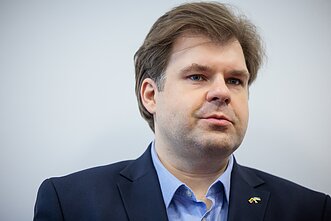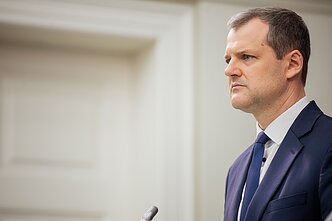





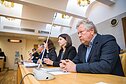


President Gitanas Nausėda delivered his annual address at the parliament, reviewing the situation in the country and its domestic and foreign policy.
The full transcript of the speech (in English) is available here.
Taking care of one’s security
As Ukraine is fighting for its freedom, Lithuania must take care of its security “without waiting for the threat of war and tyranny to cast a shadow” over its horizons, President Nausėda said in his 4th State of the Nation Address on Tuesday.
“The opportunity to pursue life goals in dignity, safety and peace is not a given. Once lost, regaining freedom can be extremely difficult. We must defend freedom each day, without waiting for the threat of war and tyranny to cast a shadow over our horizons,” the president said at the start of his speech.
“While the people of Ukraine continue their heroic struggle for freedom and the future of their country, we must ensure the security of Lithuania,” he said.
Nausėda described independence, sovereignty and democracy as “the pillars of our wealth and prosperity”.
“We received a grave warning 482 days ago, when Russia, assisted by Belarus, attacked Ukraine,” the president said. “The criminal war has been ongoing for almost 16 months.”
“The unprovoked military aggression against a historically close country has deeply affected each of us,” he said. “All of Lithuania is helping Ukraine. As a result, I believe we are now more united, stronger and more resilient.”

Lithuania has no long-term support plan for Ukraine
Lithuania does not have a long-term support plan for Ukraine, Lithuanian President Nausėda said in his State of the Nation Address.
“Political, military, financial and humanitarian aid from Lithuania and the Western democratic world is saving lives every day. Together we help Ukraine not only to withstand but also to liberate seized territories. We cannot stop,” the president said.
“Many countries have already outlined and declared multiannual military, economic and financial assistance programs, demonstrating their ongoing political commitment to Ukraine’s victory. In Lithuania, we also need to make respective decisions for the immediate future,” Nausėda underlined.
Nausėda also thanked Lithuanian NGOs, local government institutions and businesses for the support they are sending to Ukraine and for the assistance they are providing here in Lithuania.
According to the president, Ukraine will also be one of the most important issues during the upcoming NATO summit in Vilnius in July as countries will look for ways to bring Ukraine closer to the alliance.
“Ukraine will definitely be in our focus. We will discuss not only further military assistance to this freedom-fighting country but also its relationship with the alliance. Lithuania strongly supports Ukraine’s membership in NATO. We are exploring ways to bring Ukraine even closer to the alliance and to strengthen practical cooperation right now,” Nausėda said.
Specific proposals for Astravyets NPP problem
President Nausėda urged the Lithuanian authorities to come up with specific proposals on how to ensure that Belarus’ Astravyets nuclear power plant poses no threat to Lithuania.
“The issue of the unsafe Astravyets nuclear power plant remains urgent. Despite serious incidents at the plant, covered up last year and subsequently exposed by Lithuanian intelligence, the Belarus regime is proceeding with the launch of its second unit,” Nausėda said.

“The current Lithuanian government came to power with promises to bring the Astravyets nuclear power plant to a halt. Although this has not been achieved, giving up is not an option,” he said.
Nausėda said that “all governmental institutions must work smoothly and in unison” to safeguard national security.
“I have personally succeeded in having the Astravyets nuclear power plant identified as a problem affecting the entire European Union. This is reflected in the conclusions adopted by the European Council,” the president said.
“It is time for the relevant institutions to submit specific proposals for countering the threat posed by the nuclear power plant in Astravyets. We can no longer afford to wait,” he said.
It is just as important for the EU to scale down its dependence on Russian nuclear technologies, according to Nausėda.
“Rosatom deserves international sanctions for its actions not only at the Russia-seized Zaporizhzhia nuclear power plant in Ukraine but also in Astravyets,” he said.
Human rights in Belarus
The human rights situation in Belarus continues to deteriorate and the West must isolate the Belarusian regime, President Nausėda said.
Opposition leaders are arrested in Belarus, political parties are being persecuted, the media has been wiped out and active civil society organizations have been shut down, the Lithuanian president pointed out.
“The introduction of the death penalty for acts of terrorism has become a totalitarian stranglehold on society. It is the duty of the international community, including Lithuania, to isolate the Belarus regime and impose tough international sanctions,” the Lithuanian president said. “We must press for the release and rehabilitation of political prisoners in Belarus as well as for transparent and democratic elections.”
Authoritarian Belarusian leader Alexander Lukashenko cracked down on mass protests in the country after the 2020 presidential election as people demanded his resignation and democratic elections. Minsk also allowed Russia to use Belarusian territory to attack Ukraine last year.
“The regime in this country has entangled itself in a spiderweb of dependence on Russia and is now being consumed by it. At the same time, Belarus is fading. This has already led to the construction of an unsafe nuclear power plant in Astravyets and to the atrocities committed in Bucha and Irpin, where the killers wearing Russian army uniforms emerged from Belarus,” Nausėda said.

Newsletter
Every Friday morning.